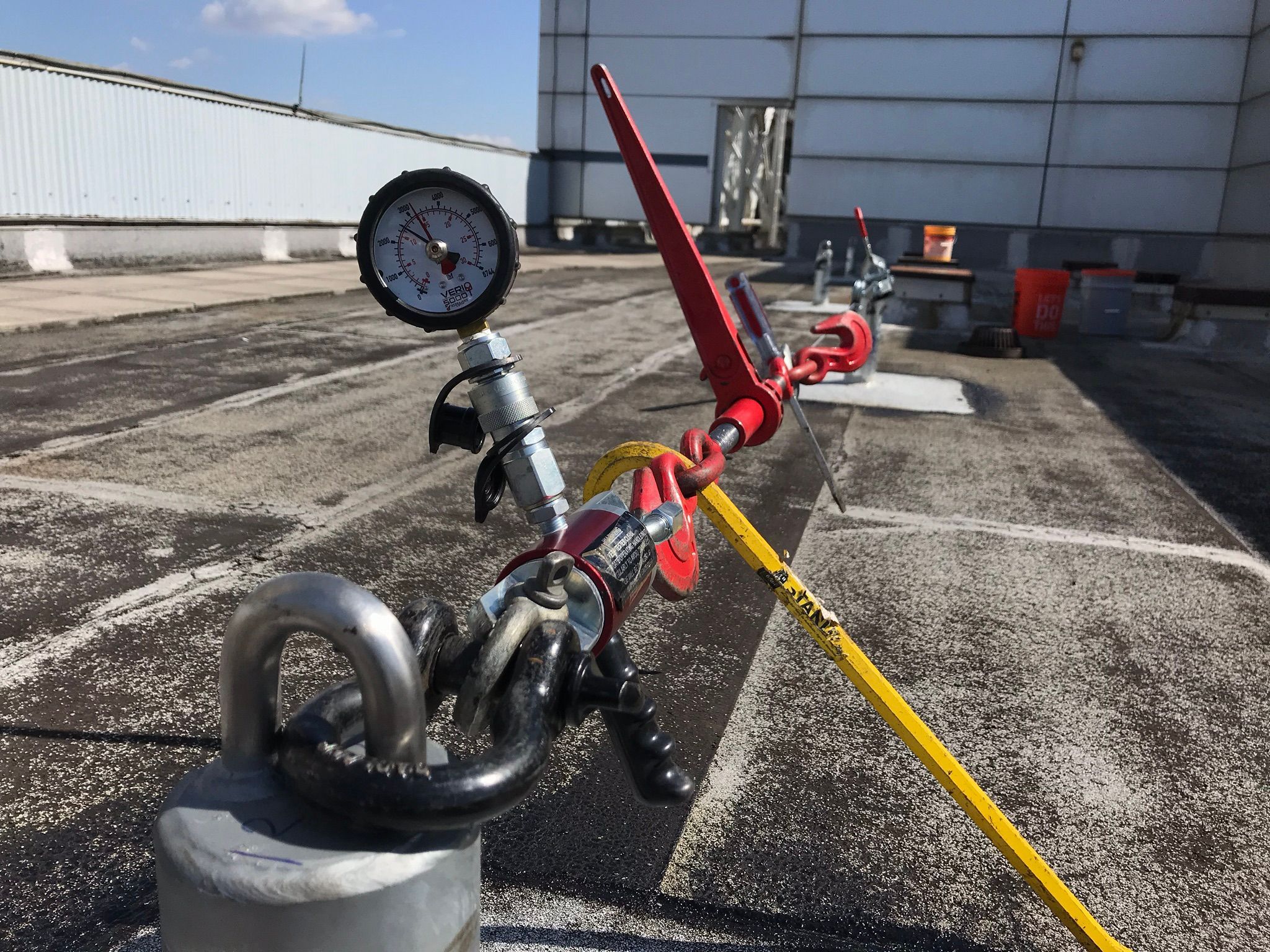

OSHA 1910.140 establishes performance, care, and use requirements for personal fall protection systems in general industry workplaces. These requirements help employers select, maintain, and use equipment intended to protect workers from fall hazards.
For building owners, facility managers, contractors, and safety professionals, understanding OSHA 1910.140 is especially important when employees work on commercial rooftops, near unprotected edges, or in elevated maintenance areas.
The regulation addresses critical components of personal fall protection systems, including harnesses, connectors, lifelines, anchorages, and fall arrest equipment.
What Does OSHA 1910.140 Require?
OSHA 1910.140 establishes criteria for personal fall protection systems used in general industry.
Important requirements include:
- Anchorages: Attachment points must meet the applicable strength or engineered-system criteria.
- Body harnesses: Personal fall arrest systems use suitable body harnesses rather than body belts.
- Connectors: Snaphooks, carabiners, and other connecting components must meet applicable strength and compatibility requirements.
- Lifelines: Horizontal and vertical lifelines must meet applicable design and performance requirements.
- Equipment inspection: Personal fall protection systems must be inspected before initial use during each workshift.
- Rescue: Employers must provide for prompt rescue in the event of a fall.
The required system depends on the workplace hazard and the protection method selected.
OSHA 1910.140 Anchorage Requirements
One of the most important provisions for commercial building owners involves anchorage requirements.
Under OSHA 1910.140(c)(13), covered anchorages must either:
- Support at least 5,000 pounds for each employee attached; or
- Be designed, installed, and used under the supervision of a qualified person as part of a complete personal fall protection system maintaining a safety factor of at least two.
These are alternative compliance criteria under this provision—not a requirement that every roof anchor undergo a 5,000-pound proof-load test.
The appropriate anchorage evaluation depends on the system’s intended use, design, documentation, and applicable requirements.
Roof anchors used with rope descent systems may also be subject to the separate requirements of OSHA 1910.27.
How Often Must Fall Protection Equipment Be Inspected?
OSHA 1910.140 requires personal fall protection systems to be inspected before initial use during each workshift for signs of damage, wear, mildew, and deterioration.
Defective components must be removed from service.
Additional periodic inspections may be required by manufacturer instructions, applicable consensus standards, or an employer’s equipment management program.
A building owner should not assume that all fall protection equipment, roof anchors, and horizontal lifeline systems follow the same inspection schedule.
OSHA 1910.140 Requirements for Horizontal Lifelines
Horizontal lifelines allow workers to move across a work area while connected to an appropriate fall protection system.
Under OSHA 1910.140(c)(11), each covered horizontal lifeline must be designed, installed, and used under the supervision of a qualified person and be part of a complete personal fall arrest system maintaining a safety factor of at least two.
This makes proper engineering, system compatibility, installation, and inspection especially important.
Building managers should maintain available documentation for permanent horizontal lifeline systems and review that information before contractors use the equipment.
What Commercial Building Owners Should Verify
Before rooftop maintenance begins, property managers should understand which permanent fall protection systems are installed and how contractors intend to use them.
Important considerations include:
- Identifying permanent roof anchors and horizontal lifelines.
- Locating available drawings and engineering records.
- Reviewing inspection and maintenance documentation.
- Confirming the systems are suitable for their intended applications.
- Identifying visible damage, corrosion, or previous modifications.
- Coordinating with contractors regarding access, equipment compatibility, and rescue arrangements.
These steps support safer rooftop maintenance and help identify deficiencies before work begins.
Frequently Asked Questions:
Does OSHA 1910.140 require every anchor to be rated for 5,000 pounds?
The standard provides alternative anchorage criteria. Covered anchorages may meet the 5,000-pound-per-worker requirement or be part of a qualified-person-supervised system with a safety factor of at least two, as specified in OSHA 1910.140(c)(13).
Does OSHA 1910.140 apply to horizontal lifelines?
Yes. The standard includes specific requirements for horizontal lifelines used as part of personal fall arrest systems.
Does OSHA require personal fall protection equipment to be inspected before use?
Yes. OSHA 1910.140(c)(18) requires inspection before initial use during each workshift. Additional inspection requirements may apply depending on the equipment.
Need Help Evaluating Your Building's Fall Protection Systems?
Shine On Anchors provides nationwide roof anchor inspections, load testing, certification, and fall protection system services.
Our team works with commercial building owners, property managers, engineers, and facility teams to evaluate existing rooftop systems.
Contact Shine On Anchors
Phone: (773) 227-4522
Email: anchors@shineongroup.com